Welcome to my holistic relief and development blog.
Blog #9: Technology
February 21, 2020
Technology is unbelievably crucial to developing countries. With simple improvements in cooking techniques and equipment, water purifiers, and machinery, their lives are improved and the technology has actually given them time back. Perhaps it could lead to them to developing their own time and resource-saving methods in other tasks.
The simple water purifier design provides more time and uses less resources than the way rural villagers were purifying their water. It removes the need for women to go find and burn firewood or coal, and instead they have more time to do other things.
Small and Medium Enterprises help the poor participate more in their economy. They provide more than 70 percent total employment in the country. Sustainable Economic Development focuses on what they are lacking and helps challenge them to meet those needs through training on things critical to the success of small business. They have an easy to use platform, local partners, and worldwide training.
Blog #8: Community Health and Refugees
February 16, 2020
From Uganda to Syria, there are many creative solutions being implemented to meet the challenges the people in those places are facing.
In Syria, children refugees are experiencing a very different life growing up and spending months or years in an overcrowded refugee camp. Living in a temporary shelter, usually a tent with no running water, no indoor bathroom facility, and sharing a shower with several other families creates a difficult existence to get used to. School is not often an option, and many children fall behind while waiting to go back to school. Education is key to their future, yet when they have been displaced, there is very little chance to keep up until things are settled again, or the countries providing oversight to the refugee camp are able to set up school for the children.
In Uganda, the government welcomes refugees from several countries, and places them in settlements rather than camps. Settlements allow them to become a new community of people, rather than containing them temporarily. There are entire areas of land that are all comprised of refugees.
In many African countries, health workers are trained and then assigned to a specific group of people. These people are trained to address the medical needs of a group of people in rural areas that don’t often have a hospital or medical facility. They bring vaccinations to the people, perform general medical check-ups, give health advice, and attend appointments with them if they request someone. This way, basic and advanced medical conditions and needs improve in rural areas.
There are many ways to address minor and major needs around the world. Some are more effective, and others less. We need to pay attention to what is working and what isn’t. The only way to continue to improve things is to study and analyze what’s happening, then move forward in our relief and development efforts. People are worth it.
Blog #7
January 31, 2020
T.S. Eliot said, “Most of the evil in this world is done by people with good intentions.”
Paternalism
Paternalism summed up would say that doing things for people in need when they could do it themselves is wrong. Some of these things include: forcing our way of doing things on them, having our youth teach them about Jesus as if our students are experts and know more than they do, managing and leading them just because we are “faster” at decision-making, undermining businesses by bringing in free resources when their local economy needs the money infused into their community, assuming we know the best way to do everything and taking away jobs they could be doing – building, farming, business). Our help should be based on major disasters and only provide immediate help until they can do it themselves again.
My experience
In 2001, our church took a construction team to Uganda, East Africa to build a home in a village for eight orphans and a house mom. The significant organization (that was based out of huge Canadian AG church) had each team send ahead $10,000 to pay for the home, and churches bringing teams meant more exposure to their ministry, more sponsors for the kids and moms, and the new house was paid for. Win-win. I loved it and ended up going back three months later and staying for four years. I lived in Uganda training kids choirs for 4-6 months, then went on tour with that group of 18 children and 10 adults for 6 months at a time around the world. I did that several times. It was the best and hardest thing I had ever done. I came back home when I was 26.
The first time I traveled there, I was 20, and like I said, our mission was to assist their building teams on the ground in mudding rows and laying bricks to build a house. It was an extremely precise job, and they had to constantly adjust our work to ensure it was done correctly. They would use a string to ensure the bricks were laid exactly straight and most of the workers were fun to talk with as we worked all day. I felt as if we were working with surgeons and we got to “try” for fun. Usually they were very good at correcting things and we would have them check our work row by row, but I also got the feeling that they could have done it much more quickly, and more accurately. It was just the organization’s way of gaining more support. We were able to get a brick home built in 4-5 workdays. 3 bedrooms, a tiny kitchen, and a small room for an in-home toilet, all built on a concrete slab. It was cozy, but airy and spacious. The windows and roof were added later.
Eventually, the organization had to discontinue this type of missions trip participation because they didn’t need any more homes built. Because of the massive amount of teams visiting, they had to hire individuals to drive the teams around, organize the safari at the end of the trip, and “babysit” them while in town. Their social workers had to catch up and fill the new homes with children, which meant their process of screening the children was rushed. No one could keep up very well. Filling the homes more quickly also meant they needed sponsors for the kids immediately, and then increased sponsorship to 7 sponsors per child to compensate for the expense. It also put far more pressure on our choir tour leaders traveling because we needed to hit certain financial numbers on our tour to sustain the village growth. There was a time they had to hit pause on growth and hire an Australian to come and do some strategic long-term self-sustainability projects at the village sites to help feed the families in the villages, and eventually to make a way for mothers to be able to sell some of the harvested produce as well. The missions teams had actually sped up the work they were doing almost too quickly and the system couldn’t keep up. They had to determine other ways to keep churches connected to the organization.
Labor and managerial paternalism there were the most obvious to me. Now, many of their villages, homes, programs, are mostly overseen by Ugandans, but the couple that has been there since the late 70’s is still leading the church, and slowly over the decades, passing it off to other people as they raise and disciple and grow people into positions of leadership. When I worked with them, they were extremely vision-driven, and I saw several people hurt along the way. I don’t know if they would agree with that statement, because they loved the Ugandans so deeply, so may not have seen how many volunteers, family members, and office staff were hurt by the way they lead with a heavy, demanding hand. Over time, I hope God grew a side of them that was more people-driven and compassionate. The silver lining is that their hard, determined side is also the reason they accomplished so much for the kingdom.
Toxic Charity
The problem with good intentions is that people take action and do what they think is “good” when the reality and aftermath look much different. Intentions can be assumptions made without the proper amount of study, information, connecting with local people, and strategy in place that equates to a self-sustaining project once you’re gone. The example of the two stories of a water well being dug was an excellent example. The well-intentioned way was to build a well, and every year come back to ensure it was repaired and functioning. No one in the village would do anything if it broke down because they knew the missions teams would come back and fix it again. They had no reason to do anything. In the second scenario, working with the village to give them a micro loan, repayment agreement, pulling together the right professionals to equip them in building their well, and teaching them to maintain and repair it when necessary, was the best way to do it. “They now owned and managed a wealth-producing asset.” (13)
In the Anatomy of Giving chapter, Lupton states, “It is delicate work, I have found, establishing authentic parity between people of unequal power. But relationships built on reciprocal exchange (…holistic compassion) make this possible.” (37) Our job in helping or giving is not to just throw money at it. Wait! But we’re so good at doing that! Yes, and it’s also easy and doesn’t often produce the results we hope for. The difficult part is strategically thinking through how to respond to a crisis and simultaneously empower the people to build, do, heal, re-create what is not working at a far less financial cost than if we just sent them a ton of money. Some of the examples given were the mess in Haiti and other world crisis that were mishandled and addressed and it created more poverty and the money thrown at it is still not doing what it was intended to do. Other examples were changing the family gift delivery to a garage-sale priced store parents could come and shop for their children, and changing the free clothing handout to a store where for bargain pricing, they could find what they needed, and even be employed at that store. Small shifts but decisions that empower the poor, instead of removing their dignity.
Need vs Relationships examines the idea that any connection that is just need-based is not life-giving or responsible, and also fosters dependency. We need to ask what we would like to see happen from the work we’re doing, and then set up a system to achieve that so that we see far greater results. The focus should not be solely on meeting needs, but building relationships while empowering the needy individuals to earn what they need. The priority is not the handout. It’s the way we hand it out and the focus is on the person.
Lupton also discussed that “vacationaries” participating in religious tourism at a cost of $2.4 billion dollars per year, are not contributing to excellent, long-term work in other countries. “Religious tourism would have much more integrity if we simply admitted that we’re off to explore God’s amazing work in the world.” (69)
Blog #6: The Root Causes of Poverty
January 31, 2020 (lecture)
In the lecture, two questions were asked that first rubbed me the wrong way, but the more I thought about it and studied, the more biblically correct they are and challenged my first-world god-like mindset.
The questions were: “Are we willing to lose power so that the poor can gain power?” “Are we willing to become poor so that the poor can become rich?”
Most of us would say no.
It’s too great of an ask and we earned what we have. The poor wouldn’t know what to do with our money anyway. We’re willing to give and share, but not decrease what we’ve “earned” so they can appear successful. But in reality, very few of us have actually earned what we have. We were born here or moved here from somewhere else, and because of that, we get to live in wealth and it can only go up from there.
Often, since we move faster in the decision-making process and have most of the money, somehow we assume we are smarter, have the answers, and can do it better than the poor. The assumption that they are somehow less important, dumber, and have no real life or financial savvy makes it logical for us to keep control, limit them in every other way, and then also squash any chance they have of self-sufficiency or doing for themselves.
If we say yes to those two questions, the way we give resources and power to people is also extremely important. It cannot be one-way giving, and it cannot be a handout. It has to be done in a way that gives up something of our own and equips them to be more successful than the current state they are in. It may be moving your family or just you to a low-income neighborhood (giving up our “safe” home in the suburbs), it may be spending extra time each week tutoring children of low-income families where the parents have 2-3 jobs to make enough money to survive and the kids would otherwise not have any extra help, it may be opening a store that is subsidized that people can shop at so that they can be self-sufficient and build confidence in their ability to provide for their family.
Either way, the current system is rigged against holistically helping and leveraging the poor out of the hole they’re in. Our well-intentioned relief is not contributing to their freedom. It’s removing any hope of getting out of desperation and poverty, and that life can be better because of who God made them to be and what He’s made them capable of.
I am thoroughly convinced after consuming the content this week that the best way to solve poverty is to live in the community you’re hoping to help change and to become an expert at relationships and doing things in a way that hands the power back to the people. To give them the opportunity to do and be who God made them to be and not just give them handouts.
The people in this world with the majority of the money (the US and other first world nations) should not be asked and expected to simply give financially. That’s too easy and does not necessitate a relationship. It doesn’t take a true partnership to just give money. That’s easy. We need more mixed, diverse communities where people are accepted and problems are solved holistically alongside the people – equipping the poor to live and succeed. One-way transactions are not the solution. I have been struggling holding my emotions in check while watching the videos, lectures, and completing the reading this week. Realizing the unbelievable amount of money that has been spent on one-way giving and religious tourism and how much damage it has done to make entire communities powerless and reliant on someone else when they have God-given abilities that we have buried by our well-meaning relief and aid. We have been proud of the work we’ve done and we don’t even know or acknowledge or take the time to ask how much damage has been done, or ask if what we’re doing is effective in solving problems. So, missions is more about how we feel about our contribution more than if it’s actually making a lasting difference to those people.
So much in our world is controlled and determined by the people with the most money: business, systems, history, identity, social standing, assumptions made and stereotypes reinforced, education being limited to the middle or wealthy classes, all of these things only reinforce and strengthens everything that is wrong about how we “rule” the world.
This is not how God wants his kingdom to look here on earth.
Blog #5: Injustice, Donors, Evaluations, Solutions
January 24, 2020 (Butrin Ch’s 5-8)
“They simply had a meeting and decided what to do.” (Butrin 108)
“Enthusiasm without knowledge is no good; haste makes mistakes.” Proverbs 19:2 After typing out five pages of notes on four chapters in From the Roots Up, this was the phrase that stood out to me the most by far. Many errors and mistakes in relief and development could be minimized and/or avoided by not making assumptions. We have every resource available to us through international communities, NGO’s, literature that never ends online and through organizations thoroughly reviewing and publishing every angle of many of the problems and challenges we hope to solve or improve in countries around the world. How foolish for us to think that we can just know a problem in a short period of time and reduce it to a meeting and decide what to do, as if we know everything. Pride is far too easy to embrace unknowingly, and it can make us ineffective in the kingdom.
To understand the steps we need to take in order to have a sound decision-making process on Holistic Development, let’s look at some of the things Butrin talked about. I appreciated reading about the difference between Social Justice and Compassion Outreach. So many of the issues people talk about today are blanket-categorized as social justice. In her book, Butrin said, “Compassion outreach, according to Cannon (2009), responds to the problems of injustice. Social justice, on the other hand, addresses their systemic causes.” (85) So good.
The book moves on to discuss the ways we can make a difference and respond to injustice. Most people are so far removed from most forms of crisis (as it’s known in developing countries), that they don’t know what to do to help, or what organizations are trustworthy to contribute to, so they just do nothing. There are ways to participate, but it takes time, and this book lists many ways.
After discussing injustice and ways to become involved, Butrin continues on in chapters six & seven by digging further into donors, workers, and decision-makers. Their processes, financial responsibility, how they interact with the local people and how they approach the development of those relationships was discussed. Also, the importance of implementing a consistent system of evaluating and assessing the work being done is priceless and absolutely necessary.
One thing expanded on in chapter seven is what a healthy partnership should look like. Partnership rests upon a foundation of mutual respect and warm personal relationships. There must be ongoing love, prayer, and fellowship. In short, unless genuine and abiding friendship develops between the partners, their relationship cannot hope to achieve the goals for which it was formed. (Butrin 128)
The final section of chapter seven was fun to read, because I love seeing things change because of assessment, evaluation, and looking at how something is being done and determine what can be adjusted or implemented to make things more effective. I’ve never seen a point in doing something just because. I love knowing the reasons behind what we do and why we do it. “Once evaluation becomes a habit and the benefits of evaluation can be seen, it will not seem to be the daunting task that some envision it to be.” (145) It is recommended to use SMART criteria (Specific, Measurable, Achievable, Relevant and Time-Bound). After that, discussion has to include a plan of action, budget planning, and evaluation.
Chapter eight moves on to Sustainable Solutions. The Microfinance section was completely fascinating. I loved reading about the history of that model. Brilliant.
It will take time to develop local, ongoing partnerships and create thoughtful solutions that transform communities and lives, but it is all worth it. “We must be willing to lay aside our time consciousness and our need for immediate gratification in deference to the process of time that may be required for true change to take place. We truly need to honor the dignity and worth of those we desire to work alongside and realize that no matter their plight in life; they have giftings and talents and resources to bring to the table.” (170)
Blog #4: A Week of Food! How much does it cost?
January 19, 2020
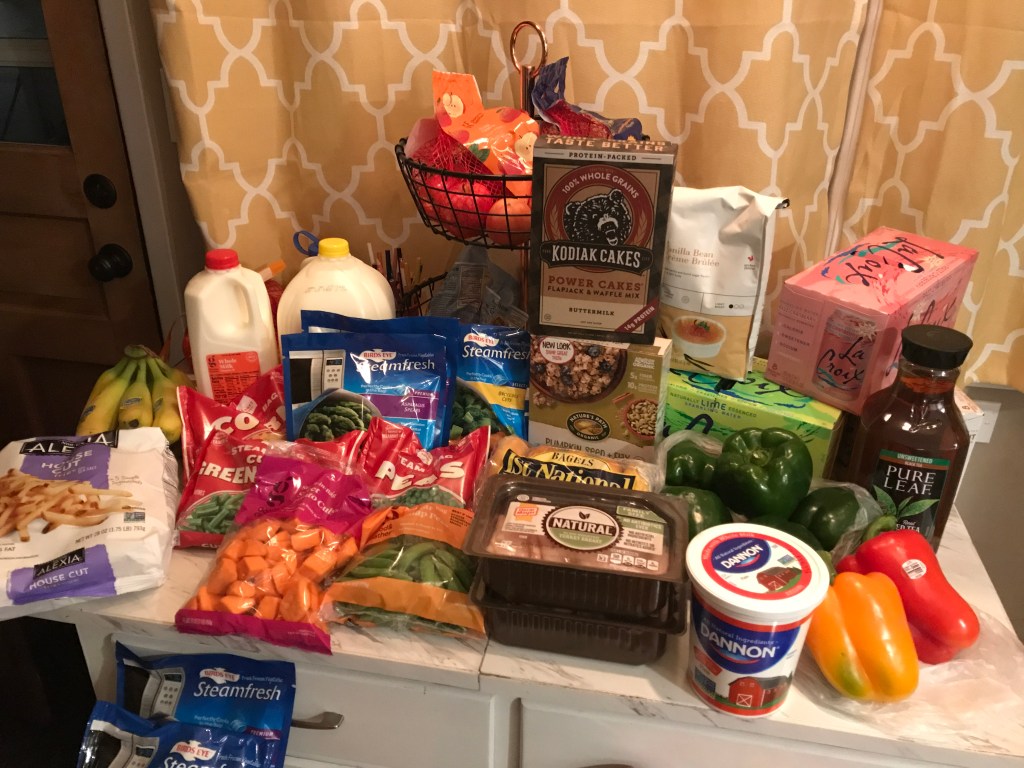
Living in a high income country of the world, our family is privileged to spend whatever we want to per week on groceries of all different kinds, fresh, frozen, pre-cooked, high quality meats and other foods. We have every option available to us in order to be healthy. So many countries don’t have that chance/choice. Knowing this, I still try to ensure we’re not unnecessarily spending money and being wasteful. Sometimes, we buy groceries every 2 weeks in order to use much of what’s in the pantry, and remaining fruits/veggies instead of letting them go bad and just buying more. I shop for my family of 5 people typically every week or week and a half. It’s a little difficult to calculate what I spend only on myself – with the exception of times I’m at a coffee shop studying or working on something a couple times per week. So, knowing that, I’ll calculate what I spent for our family for the week.
Groceries: twice a month or so, I order groceries on my phone through Shipt.com, and they drop it off at my door. It’s amazing and a luxury I totally take advantage of. We tend to purchase a few things here and there in between full grocery shopping trips.
Breakfasts…$65: Coffee ($10), almond milk creamer ($4), bagels (2.50) and cream cheese ($3). oatmeal ($2.50), fresh (apprx. $5) & frozen fruit ($8/bag), cereal ($3/box-Kix or plain Cheerios), 2% milk ($3/gallon), whole milk ($4), eggs ($3/box), yogurt ($4-5/container), granola ($2.50) Much of this we have around, so we don’t have to buy this every week. Twice we had coffee at Caribou – $10.
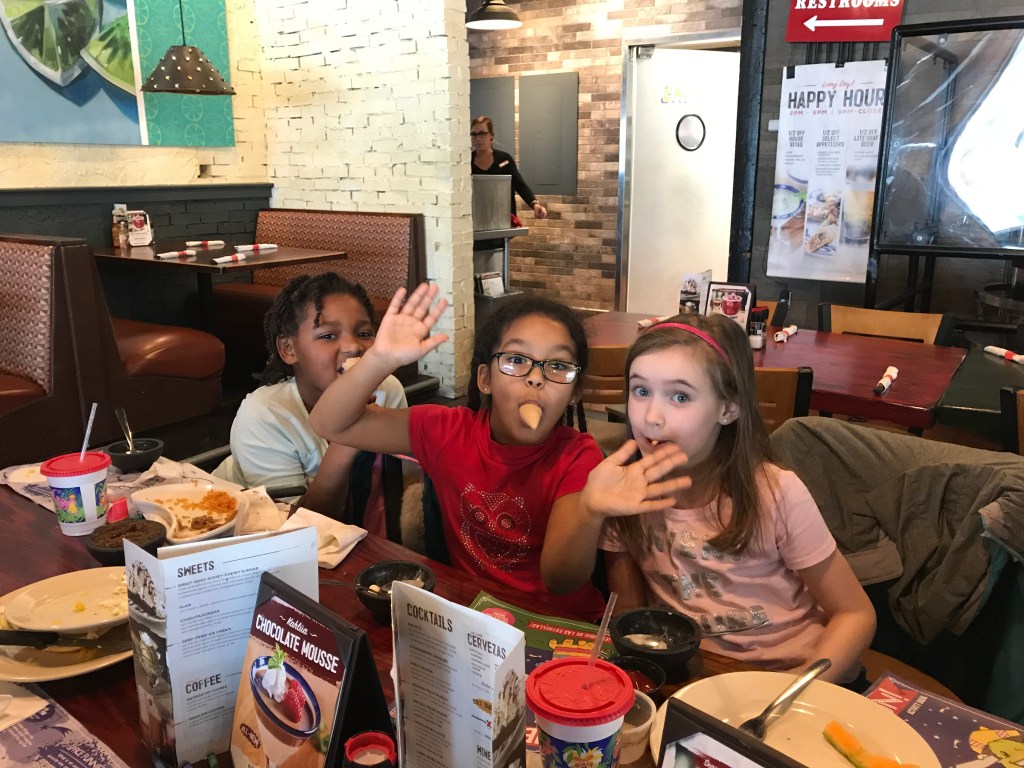
Lunches…$70: Everyone is usually at home for lunch, so it’s a mix of leftovers, string cheese ($3), fruit, milk, bread ($3), lunch meat ($6), bell peppers ($4), carrots ($2), olives ($1.25), peanut butter ($5), unsweetened applesauce ($2/each, 2-3 containers each week=$6), and other miscellaneous items. Sunday, we had lunch with family at Chevy’s restaurant ($40).
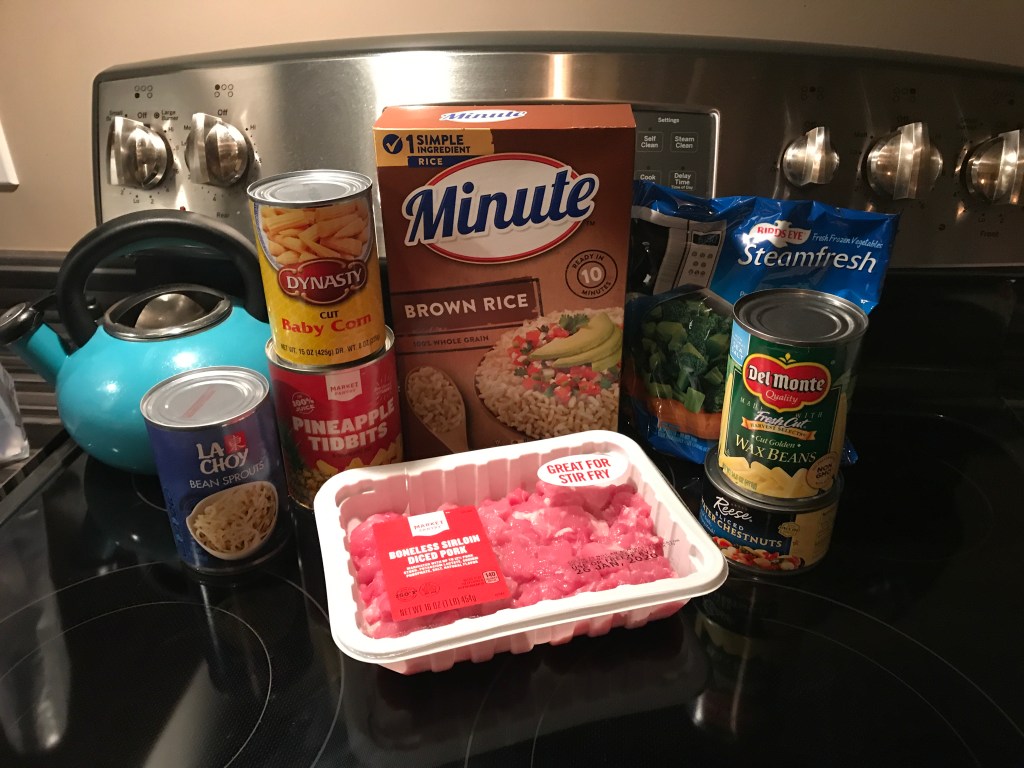
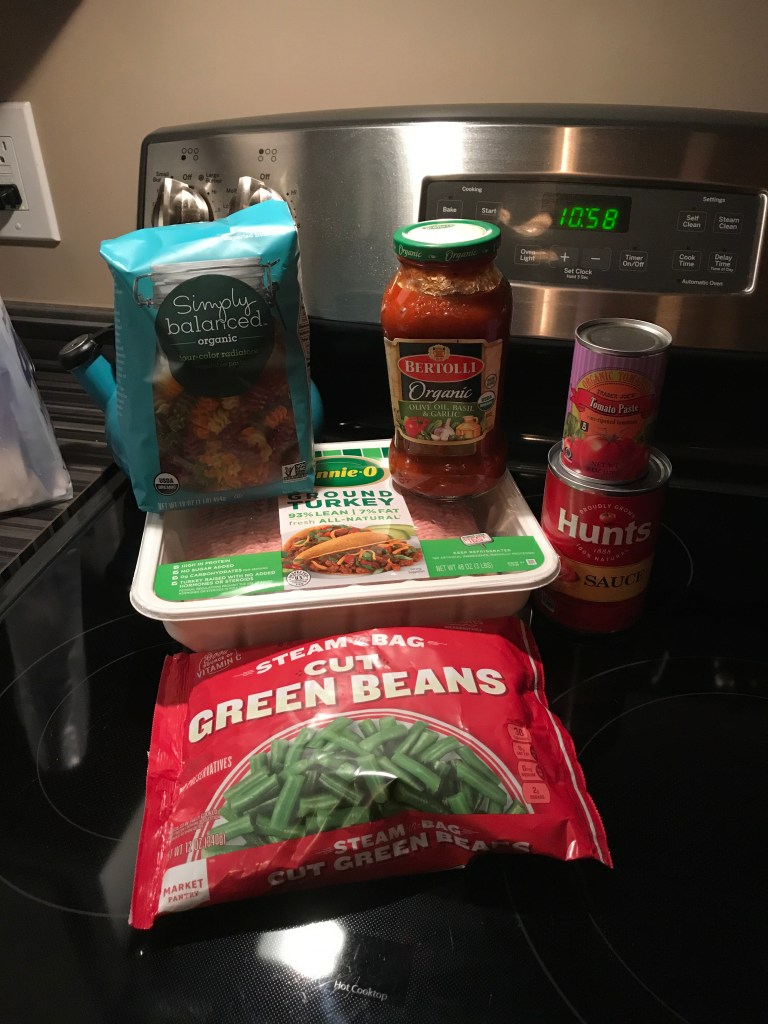
Dinners…$94: This is different every week depending on who’s home, and how much time we have to cook. This week, we cooked most of the time. Monday – we had soup ($5) and steamed veggies ($3). Tuesday – I had a study night at Jason’s Deli – salad, sandwich ($11), the family had breakfast for dinner ($10). Wednesday – we paid $18 for the entire family to eat at church before their Wednesday evening classes. Thursday – Stir Fry, chow mein noodles, brown rice (apprx. $15). Friday – pepperoni pizza ($4) salad ($3), ice cream sundaes ($8) (for Family Fun Night!). Saturday – Dutch baby German Pancakes and fresh fruit topping (ingredients on hand). Sunday – dinner-stuffed peppers ($.89/each, made 5 peppers=$4.50), ground turkey ($6), sauce ($2), parmesan ($3), mozzarella ($2).
So, for the entire week, we spent approximately $229 for the 5 of us, or approximately $45.80 per person for the week, or $2.18 per person per meal for 21 meals, or $2.54 per person per meal for 18 meals (if there were a couple I didn’t account for). Per person per meal that seems low enough, but our expenditures seem high when we know how little billions of people around the world spend. We are wealthy and certainly spend that way. Our wealth gives us lots of choices, and we generally take advantage of those conveniences.

From the Roots Up: Compassion
January 17, 2020
Real compassion is hard. I thought I knew what it was, and it was relatively easy. Compassion just takes thinking beyond yourself a little; it doesn’t even take up much time. I thought it was handing a dollar to someone on the street. Maybe it was giving financially to relief efforts, or throwing a toy into the Toys for Tots bin around Christmas. It was checking in on someone when it was convenient to do so, or feeling sad and putting an arm around someone that is hurting. This is not the true depth of compassion. Compassion is void of ego and doesn’t count the cost. It is completely invested and committed to seeing the story out to the end. It’s being in the middle of people’s lives, knowing their emotions, personalities, greatest moments, and deepest pain. It’s a long-term investment and incredibly time-consuming and personal.
In Joann Butrin’s book, “From the Roots Up”, she describes compassion as, “…literally it means with passion, suffering with or feeling the distress of another. Just as courage takes its stand by others in challenging situations, so compassion takes its stand with others in their distress.” Butrin also says compassion includes the reality of other persons, their inner lives, their emotions, as well as their external circumstances. “Compassion elicits hard work. (Butrin 24-25)” Hard work is not convenient, a handout, or a quick fix.
Is it possible to show deep, genuine compassion while also maintaining a significant ego obtained because of what we feel like we’ve accomplished or completed for someone?
I’d argue ego and compassion cannot co-exist.
When the need met was so large that we spend time thinking about it, talking about it, posting it on social media, and telling people (with the intent of inspiring them, of course), and don’t keep it to ourselves, it’s just to build our ego and ask to be praised. It’s no longer about who we helped, but more so how people viewed our heroic act – big or small. Don’t misunderstand me. Compassion isn’t about the bigness or smallness of our compassion or care in that moment, it’s how invested we are in that person or people group to begin with and who we’re doing it for. Are we with them, standing by them, building them, and sharing our lives with them, or simply meeting a need or building our ego? Compassion is far more than just meeting a need or being seen serving.
When addressing situations of extreme need, many times missionaries and non-profits can have a “Savior” mentality and they sweep in to solve problems without working with the people. That attitude lacks depth of compassion. To approach a situation, size it up, and then decide what people need without asking them, massive mistakes can be made, and the actual need might not be met. Just doing and accomplishing can build our ego, but we’re called to show compassion and do it with them, not for them. Butrin states, “…we can help best by helping people to help themselves. We still want to do for, instead of do with, or just do it ourselves (Butrin 57). This also removes the local people’s ability and drive to accomplish and do for themselves because they know and get accustomed to others doing the work for them. They will not advance or become better without being equipped to do the work that solves problems in their own communities. This is why compassion and working alongside people is so very crucial.
Compassion is more difficult and involved than I previously thought. It is entirely necessary work because Jesus showed us that it must be part of spreading and sharing the Gospel with the world.
What we do should be genuine and from the depth of who we are in Christ and how much we love Jesus. It doesn’t matter who sees it or knows how great we are (or aren’t). True compassion is far better than that. Let’s be better.
Shalom
January 17, 2020
Shalom. A word that is not used on a daily basis in most homes, but a word that has far more meaning and depth than most people realize. Prior to this class, I had the assumption that Shalom simply means peace, and I didn’t think much beyond that and hadn’t taken the time to study it in depth.
Shalom is when everything is right. Calm, refuge, shalom with God, prosperity and hope, healing, lack of terror or tyranny, spacious and quiet land, God’s dwelling with us, and so much more. Nothing is lacking or broken.
The cross accomplished a restoration of peace in Jesus. A true shalom.
The kind of God that people need to see today is a God of peace, comfort, and shalom. There are so many broken homes, families, relationships, countries, political parties and messes, and so many other damaged things in need of God’s Shalom. People need to see the people that claim to know God and follow Him walk in his peace and shalom. We need to carry his love, restoration, peace, and hope to people and families that cannot see who He is. We get to demonstrate that – knowing how great He is and how He can heal hearts and right wrongs and bring people together that are unable to do it themselves.
God is love. He is also a God of restoration and hope.
Global Wealth Inequality
January 10, 2020
It’s far easier to distance ourselves from a topic when we aren’t able to realistically grasp why it should be important to us. Why should we care about wealth inequality, or where we lie on the scale of global wealth if it doesn’t impact our daily existence? To choose to put a stop to our self-centered mindset and improve the world we live in, we must be intentional, informed, and clever enough to choose to care about who controls the wealth so that we know how to navigate the challenges and opportunities that come with our affluence. The time to think beyond ourselves and utilize our undeserved wealth to help is NOW.
In the United States, we are automatically in the high-income country category which includes 1.3 of the 7.7 Billion people that live on Earth. The annual US median household income as of 2018 was $63,179 (census.gov). Some other countries in this category are Poland, Norway, Switzerland, United Kingdom, and Japan (Sider 9).
What do you think of when you hear the term wealth inequality? Slums versus mansions? A woman in tattered clothing with a jug on her head on a dirt road versus a glamorous celebrity attending a red-carpet premiere? How does talking about this matter to us? Since many Americans wrongly assume they’re in the financial lower or middle world class (and not actually on top), they feel the freedom to dismiss some issues and instead make their own way and just focus on building their own lives.
Low-income countries in the world (847 million people) qualify for that title by making less than $1,035 according to the GNI (Gross National Income). (Sider 8) Countries included here are: Nepal, Cambodia, Bangladesh, North Korea, Afghanistan, and many African countries, including Ethiopia, Burundi, Chad, Tanzania, Rwanda, and Malawi.
Not thinking that you or I have affluence to use for God’s kingdom and the world leads to less need for anyone to actually take responsibility and make positive changes. It’s not my fault, so I don’t get involved. It’s not your fault, so you should just buy more stuff, a bigger house, a nicer car, and maybe donate to charity if you made an extra chunk this year – unless of course, you’d rather spend it on yourself (which is encouraged). So, the wealthy continue to grow and expand, and the lower class actually gets poorer. The middle class has been being eroded for decades, and people are being pushed one way or another – up or down. This massive shift has been rapidly taking place, and thousands if not millions of people are unaware it’s even happening.
Global Wealth Inequality is a thing. It’s happening. We didn’t deserve to hit the jackpot by being born in the US. But many of us were. It’s time we use our affluence to make a difference.
Here we go…this is my intro!
Holistic Relief and Development
This class is going to be awesome. I have worked in the projects in New Orleans, the villages in Uganda, East Africa for four years, the inner city of Los Angeles, special needs facilities in Guatemala, and everywhere in between. I have been a kids pastor in Dallas, a preschool pastor in Minnesota, and volunteered in more areas than I can list here. I’m a mom of 3 and I am educating them at home because it gives us the most influence over them and a ton of life flexibility that we wouldn’t have otherwise. We take three week road trips across the south to visit family, and although they are young now, someday, I will be taking them with me back to Africa and maybe South America too. This class will continue to give me insight into how we are to approach relief and development in a holistic way which I am very excited about. It doesn’t matter what you know and what you’ve experienced, there is always much more to learn and understand.
I have recently been invited to be on the board for an orphanage in Belize, and my questions are definitely more attached to that project right now than anything else. How we are supposed to meet physical/ spiritual/ emotional needs, build and disciple leaders locally to sustain the work, and get real results on the ground are all crucial topics to wrestle with when working in various low-income cities and countries. I’m looking forward to discovering better solutions and more effective methods for relief and development. Let’s do this!
Follow My Blog
Get new content delivered directly to your inbox.
 Candace's Blog